
Travel alerts & warnings
Afghanistan driving guide.
Driving in Afghanistan involves damaged roads, unpredictable traffic, armed checkpoints and limited emergency assistance. Many governments advise against all travel because of terrorism, kidnapping and arbitrary detention; an International Driving Permit does not make independent road travel safe or guarantee permission to drive.
- Advisory
- Do not travel
- Drives on
- Right
- Best season
- April to June…
- Permit honored
- Yes
USIDA member value-add
Build a driving trip in Afghanistan
Tell us how long you have and what you like. We'll lay out a realistic day-by-day drive with stops, drive times and local road notes.
Takes a few seconds — free for members.
Level 4: Do Not Travel
Do not traveldue to civil unrest, crime, terrorism, risk of wrongful detention, kidnapping, natural disasters, and limited health facilities.
- Do not travel to Afghanistan for any reason
- We urge American citizens in Afghanistan to leave immediately. U.S. citizens seeking U.S. government help to leave the country should email their complete biographic details, contact information (email and phone number), and U.S. passport number to AfghanistanACS@state.gov.
- The U.S. Embassy in Kabul suspended operations in 2021. The U.S. government cannot provide routine or emergency consular services to U.S. citizens in Afghanistan.
- The Taliban actively surveil and monitor travelers. U.S.-Afghan dual nationals and U.S. citizens linked to NGOs face higher risks of surveillance. The Taliban’s so-called General Directorate of Intelligence (GDI) and the Ministry for the Promotion of Virtue and Prevention of Vice and Complaints (PVPV) are responsible for enforcing directives and edicts issued by Taliban authorities.
- Multiple terrorist groups are active in Afghanistan. U.S. citizens are targets of kidnapping and hostage-taking, and may become targets for violence.
- There is a high risk of wrongful detention of U.S. nationals in Afghanistan.
Driving there
Your permit in Afghanistan
- Afghanistan honors the International Driving Permit. The permit is a translation of your license into ten languages — it is not a license on its own.
- Carry your valid U.S. driver's license with the permit at all times. The permit is valid for one year and only while your U.S. license is valid.
- Not party to the 1949 convention; the International Driving Permit is honored.
- Rental companies and local police can be stricter than national law. Confirm the requirement with your rental company before you travel.
Advisory information is published by the U.S. Department of State and reproduced here for convenience. It can change at any time — always check the official advisory before you travel. USIDA does not issue travel advisories.
Before you drive
Top travel tips for Afghanistan
Road rules and conditions
Keep right, overtake on the left only when clearly safe, and use seat belts. Expect pedestrians, livestock and vehicles travelling against traffic. Avoid night driving and never leave established roads or paths because of mines and unexploded ordnance.
Tolls and road payments
Tolls or other road charges may be collected on some routes, but arrangements can change. Carry small-denomination Afghan afghanis, ask your local operator about current charges, and request receipts where available; do not assume every checkpoint payment is an official toll.
Fuel
Petrol and diesel are available in major cities, but rural supplies and fuel quality can be unreliable. Refuel before leaving an urban area, confirm the correct fuel with the attendant, and carry cash rather than relying on cards.
Speed limits
Follow posted limits and have a reputable local operator confirm current restrictions; reliable nationwide numerical limits are difficult to verify, and signs may be absent. Drive well below any posted maximum where potholes, dust, crowds or blind mountain bends reduce visibility.
Rental vehicles and police checks
Conventional self-drive rentals are limited; a vetted local vehicle-and-driver arrangement is more practical but does not remove the security risk. Do not assume an IDP is accepted: confirm licensing, insurance and route permissions locally. Carry your passport, visa, home licence, IDP and vehicle documents, approach Taliban checkpoints slowly, keep hands visible, and avoid photographing personnel or installations.
Worth the drive
Places to see in Afghanistan
Babur's Gardens
Kabul · Approximately 20–45 minutes from central Kabul, depending on traffic and checkpoints.
Historic terraced gardens containing the tomb of the Mughal emperor Babur; access must be checked locally.
Qargha Reservoir
Kabul Province · Approximately 45–90 minutes from central Kabul.
A lakeside setting beneath the foothills west of Kabul; visitor access and local restrictions can change.
Bamiyan Buddha Niches
Bamiyan Province · Approximately 10–20 minutes from central Bamiyan; confirm access to the archaeological areas.
The monumental empty niches and surrounding archaeological landscape preserve evidence of the valley's Buddhist history.
Band-e Amir National Park
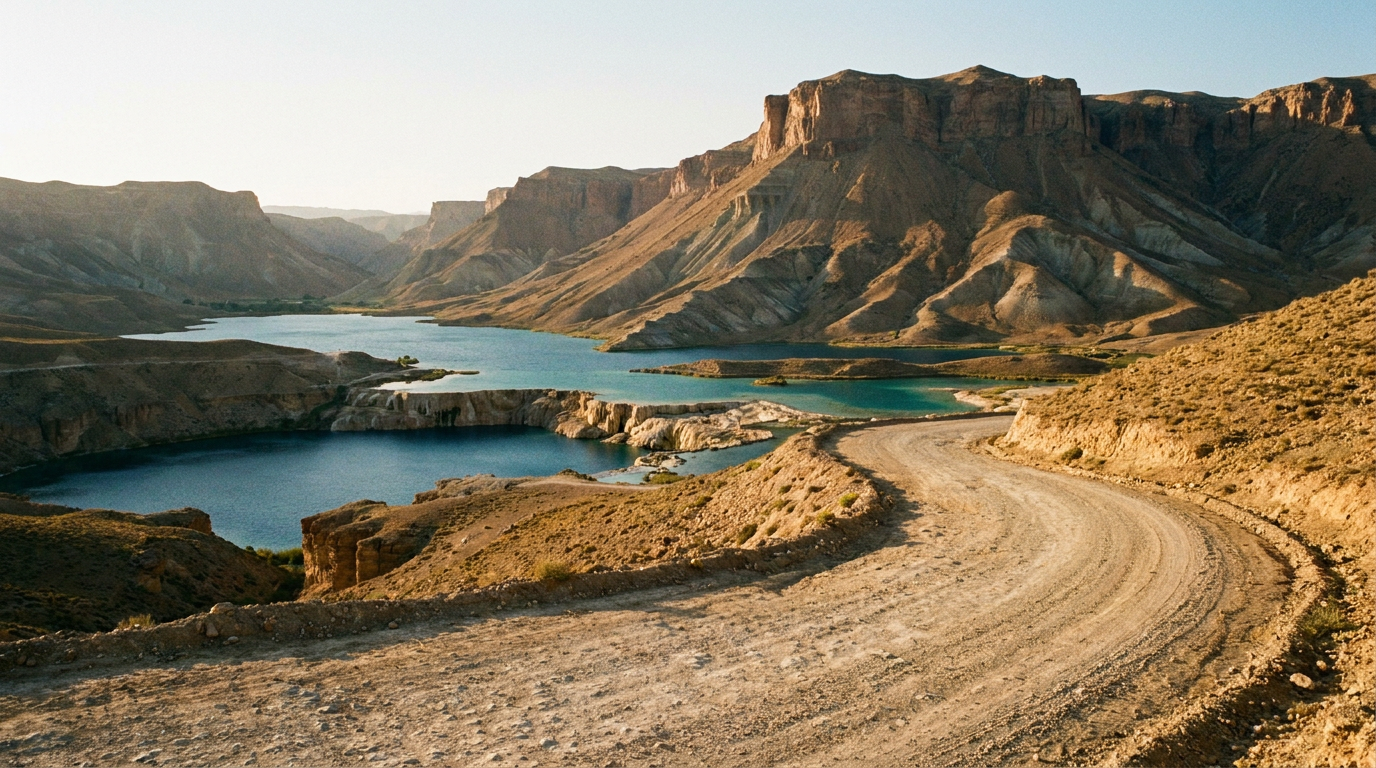
Bamiyan Province · Approximately 2–3 hours from Bamiyan in suitable weather; snow and road damage can prevent access.
A striking chain of blue lakes separated by natural mineral dams; Taliban restrictions have barred women from visiting, and current access requires confirmation.
Herat Citadel
Herat Province · Approximately 10–20 minutes from central Herat, excluding any required walk to the entrance.
A restored fortress overlooking Herat's historic centre, with substantial mud-brick walls and towers.
Shrine of Hazrat Ali, commonly called the Blue Mosque
Mazar-i-Sharif, Balkh Province · Approximately 10–20 minutes from central Mazar-i-Sharif, with final access potentially on foot.
A major religious landmark known for its blue tilework; dress requirements and access rules, including entry for non-Muslims, must be checked locally.
Heading to Afghanistan?
Apply online in about ten minutes. We print and mail your permit, and you can track it the whole way.